|
why i love the Dark Materials trilogy...
The best stories work on three levels: (a) the level in which the story and plotline is really cool and leaves you breathless with anticipation AND you can identify with some character in it, or a situation that a character finds himself in; (b) on the level of allegory; and (c) simply on the level of beauty -- where you find yourself transported by the writer's way of stringing words together, and the images and situations she conjures up resonate inside you like nothing else.
The most beloved works of children's literature have this multi-layered quality... one need think only of J.R.R. Tolkien, C.S. Lewis, Lewis Carroll (among many others) to ascertain the fact. Bringing the list of worthies into the late 20th century, I would include Orson Scott Card, J.K.Rowling, and Philip Pullman.
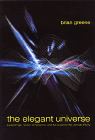
Pullman's His Dark Materials trilogy has a great plot with wonderful, unforgettable characters, is written in exquisite, poetic language, and contains one of the most perfect, penetrating allegories of the physical universe that i've read in recent years. Which explains my use of that picture above, of the book that's next on my reading list, Brian Greene's The Elegant Universe. From the book's blurb:
In a rare blend of scientific writing as elegant as the theories it explains, Brian Greene, one of the world's leading string theorists, peels away the layers of mystery surrounding string theory to reveal a universe that consists of eleven dimensions, where the fabric of space tears and repairs itself, and all matter--from the smallest quarks to the most gargantuan supernovas--is generated by the vibrations of microscopically tiny loops of energy.
And that, basically, is a "scientific" version of the imaginary worlds Philip Pullman conjures up in his trilogy. While the theoretical physics aspect of string theory is beautiful in and of itself, one needs to look to storytellers and novelists to inscribe a human context to the reality. And in this, Pullman succeeds brilliantly. The trilogy ain't just a children's book, dear ones, though it does serve quite well for the genre and I look forward immensely to reading from it at bedtimes, to my nephew and niece in Hawaii, very soon.
Now, since you're all brilliant young kids in your own rights and spheres, I recommend you also read The Elegant Universe either concurrently with the Pullmans, or immediately afterward. I guarantee the experience will be mind-blowing. What? You don't have time, you say? Nonsense. You can make time... either by prioritizing school/leisure better, or procrastinating less. It's your choice, really. But if you crave an intense mental and intellectual experience quite unrelated to the quotidian challenges facing you in school, then consider this excellent Pullman/Greene duo. Stretch your minds... extend the horizons of your universes. Find time.
|
Sep
Nov
{ net.casting }
^
|