|
finding fresh water... in the ocean.
in the southernmost tip of Maui, there's a bay called La Perouse, so named for the French explorer who 'discovered' it in the late 1780s. of course, there was already a thriving native Hawaiian population living in that area, properly called Keone'o'io, "the sandy place with bonefish." today, only the low lava rock walls and foundations remains of the settlement, which was destroyed by the last eruption and lava flow on Maui, in 1788. so to the present...
my brother Peter and I have hiked around this desolate but starkly beautiful area. the lava flow goes right into the sea, which makes for very strenuous hiking. this side of Maui is very dry; not at all the green, tropical lushness that comes to mind when you think of 'Hawaii.' the microclimate approaches that of a desert region, and the plant life reflects this. the point here is that this is still the same environment that the ancient Hawaiians in the seaside village of Keone'o'io lived in. rain falls rarely here, and there are no streams that come down from the flanks of the volcano on this side of the island. so, as my brother and I explored this area, often running into the remains of heiau (temples) or lava rock houses, we wondered where on earth did the Hawaiians get their fresh water? did they have to schlep them from miles away up or down each coast? unlikely, given the unforgiving terrain.
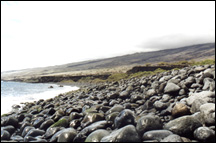 so we asked one of our Hawaiian friends, a local kupuna (teacher), what the deal was here. she told us an amazing thing: the villagers of Keone'o'io got their fresh water... from the ocean. and no, they did not have desalinization factories. it turns out that the ground under the south Maui coastal area is porous with lava tubes and fissures, with some extending deep enough to the aquifer (where fresh underground water is found) such that they're effectively wells [diagram]. however, the top openings of these wells are often in vents well past the shoreline, underwater. as this is a lava flow area, there is no beach and in fact the bottom drops off steeply to the ocean floor. along these cliffs, just beneath the ocean surface, are the openings of these fresh water vents, or springs. so we asked one of our Hawaiian friends, a local kupuna (teacher), what the deal was here. she told us an amazing thing: the villagers of Keone'o'io got their fresh water... from the ocean. and no, they did not have desalinization factories. it turns out that the ground under the south Maui coastal area is porous with lava tubes and fissures, with some extending deep enough to the aquifer (where fresh underground water is found) such that they're effectively wells [diagram]. however, the top openings of these wells are often in vents well past the shoreline, underwater. as this is a lava flow area, there is no beach and in fact the bottom drops off steeply to the ocean floor. along these cliffs, just beneath the ocean surface, are the openings of these fresh water vents, or springs.
to get at the fresh water, the ancient Hawaiians used gourds and dived down to the fresh water springs. according to our friend, it was easy to find--the salty ocean water was much warmer than the spring waters.* so, as soon as a diver met a region of cold water, he or she knew that they were at the right place, and could then replace the saltwater in the gourd with fresh. a more difficult way of fetching water is hard to imagine! it's not like a nice little swim, either, the ocean here can be rough, and the lava beach treacherous. just goes to show you how the ancient Hawaiians were ingenious, hardy, and true survivors.
* (in fact, at certain surfing spots on the Big Island, as the end of the day when it's time to go home after surfing, surfers and kids will dive down to a freshwater spring before emerging back up to the beach, and therefore don't need a fresh-water shower! a very cold, but quite convenient little detour, eh?)
|
Aug
Oct
{ net.casting }
^
|


